
What We Offer


- Routine Check-ups: This is a complete health check for your entire mouth. We look beyond cavities to assess your gums, bite, and existing dental work—all to promote long-term oral wellness.
- Professional Teeth Cleaning
- Ultrasonic Scaling: Thorough cleaning to remove the hardened buildup (tartar) that your brush can’t touch.
- GBT Airflow Cleaning: We use this comfortable, minimally invasive technology to remove soft plaque and stains. It’s clean, efficient, and protects your gums.
- Digital X-rays & Intraoral Scanning: We use advanced, low-radiation digital imaging. These tools give us an essential, accurate view inside your teeth and bone, helping us plan your care precisely.
- Fluoride Treatments & Dental Sealants: We apply topical fluoride to strengthen your enamel to guard it against decay.
- Custom-Fitted Mouth Guards:
- Night Guards: If you clench or grind, this custom-made barrier protects your teeth from wear and tear, reducing jaw pain and tension.
- Athletic Mouth guards: Custom guards that offer superior protection against dental injury during sports.
- Personalized Oral Hygiene and Dietary Guidance: We give you tailored advice on brushing, flossing, and diet to help you optimize your home care and maximize your health between visits.
- Early detection fixes minor issues before they become major problems.
- Ultrasonic scaling and GBT Airflow provide a comfortable, minimally invasive experience.
- We use advanced technology like Digital X-rays and intraoral scanning to get a clear, highly accurate view of your health with minimal radiation.
- Custom-made guards and protective treatments shield your smile from injury, wear, and decay.
- How often should I visit the dentist?
Ideally, you should visit us every six months. Regular check-ups are essential for the early detection of issues like decay, improper bite, and gum disease—addressing small problems now prevents the need for serious dental procedures later. - Do I need a check-up even if my teeth don’t hurt?
Yes, some dental problems, like early decay or gum disease, don’t cause pain until they become advanced. Routine check-ups allow us to find and fix minor issues before they become painful or complex. - What to expect during a professional teeth cleaning ( or a hygiene visit)?
General Dentists thoroughly remove plaque, tartar, and/or stains using advanced tools like ultrasonic scalers and GBT (Guided Biofilm Therapy). This keeps your teeth and gums healthy, reducing the risk of inflammation or decay. - What is the difference between regular cleaning and deep cleaning?
Regular cleaning is for healthy gums and focuses on the visible surfaces of the teeth. Deep cleaning (scaling and root planing) is a therapeutic procedure needed when gum disease is present, targeting tartar and infection below the gumline. - Are dental X-rays really necessary? Are they safe?
Yes, they are necessary. X-rays show us hidden issues—like decay between teeth, bone loss, or impacted teeth—that aren’t visible during a visual exam. We use digital X-rays with minimal radiation and strict safety protocols. - What can I do at home to prevent cavities?
The best defense is consistency: brushing twice daily with fluoride toothpaste, flossing every day, limiting sugary and acidic foods/drinks, and maintaining your six-month professional visits. - My gums bleed when I brush—what should I do?
Bleeding gums are usually a sign of gingivitis (early gum disease) or improper brushing technique. Do not ignore it. Maintain gentle but thorough cleaning and schedule an appointment at Second Grinnings right away so we can diagnose the cause and treat it quickly.

- Teeth Whitening (Laser-Assisted): We use specialized gels activated by a dental laser to break down stains. This process gives you a significantly brighter smile in just one comfortable visit.
- Porcelain Veneers & Lumineers: These are thin, custom-made porcelain shells bonded to the front of your teeth. They are a great solution for correcting chips, gaps, discoloration, or minor misalignment, creating a flawless, natural look.
- Smile Makeovers: This treatment plan addresses all your aesthetic concerns and helps you achieve a smile that feels truly natural.
- Cosmetic Contouring: A quick, painless procedure where we make tiny, precise adjustments to the shape of your teeth.
- Gummy Smile Correction: If you show too much gum when you smile, we can correct this with gentle dental lasers.
- Gum Depigmentation: This procedure uses a dental laser to remove dark or uneven spots on your gums caused by excess melanin. It’s a simple, effective treatment that restores a healthy, uniform pink color to your gums.
- Get a significantly brighter smile in a single visit.
- Transform imperfections into a flawless, natural-looking smile.
- Achieve your dream smile with a completely customized plan.
- A quick, painless way to correct minor imperfections and refine your smile.
- Achieve an even, healthy-looking gum tone with laser precision.
- Is teeth whitening safe?
Yes, laser-assisted whitening is a safe procedure when performed by a professional. - Are veneers permanent?
Veneers are a long-lasting, irreversible treatment that can last for many years. - What is a smile makeover?
It is a tailored combination of cosmetic treatments to create an ideal smile that suits you. - Does cosmetic contouring hurt?
No, it’s a painless procedure used to make small, subtle improvements. - Is gum depigmentation a painful procedure?
No, it’s a minimally invasive, laser-assisted procedure for a uniform gum tone.
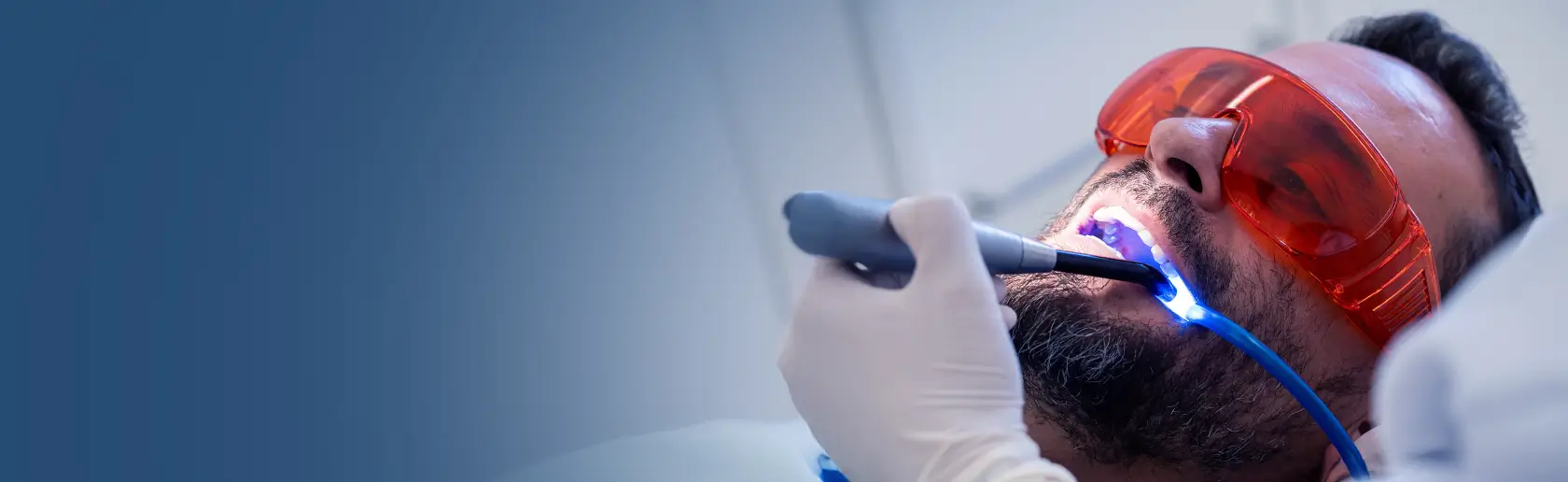
- Tooth-Coloured Fillings: These are natural-looking fillings that are custom-matched to your tooth’s color. These fillings repair minor damage from cavities or small cracks and restore the tooth’s shape and strength.
- Crowns, Bridges & Inlays/Onlays:
- Crowns: These are like a cap for a tooth that’s been severely damaged. They cover the entire tooth to restore its strength and appearance.
- Bridges: A bridge is a fixed solution used to replace one or more missing teeth, using the teeth on either side as anchors.
- Inlays / Onlays: When a tooth has moderate damage, but a full crown isn’t needed, we use these custom-made, lab-fabricated fillings to restore the tooth’s structure.
- Full Mouth Rehabilitation: This treatment plan is used for those cases where many teeth are damaged or missing. Here, a combination of treatments like crowns, implants, and veneers is used to fully restore your bite, function, and aesthetics.
- Laser Cavity Detection & Treatment: We use advanced lasers to safely and painlessly find even the tiniest cavities. This allows us to treat the decay in its earliest stages.
- Laser Treatment for Sensitivity: If you have sensitive teeth, we can use a gentle dental laser to seal the tiny tubules on your tooth’s surface. This blocks the signals that cause pain, giving you fast and effective relief.
- Instant relief from tooth sensitivity with simple laser treatments.
- Advanced laser technology helps in the early detection of cavities.
- Seamlessly restore teeth with natural-looking fillings and rebuild their strength with crowns and bridges.
- How do you fix a missing tooth?
We offer a few options, with the most common being a bridge. This is a fixed solution that uses the teeth on either side of the gap as anchors to support a new, artificial tooth, filling the space permanently. - What does full mouth rehabilitation mean?
It’s a complete oral makeover that uses a combination of procedures—like crowns, implants, or bridges—to fully restore function, form, and aesthetics. - Does laser treatment for sensitivity really work?
Yes, it’s a highly effective solution. The laser works by sealing the tiny, exposed tubules on your tooth’s surface that cause sensitivity. This provides quick and long-lasting relief from pain caused by hot or cold foods and drinks.
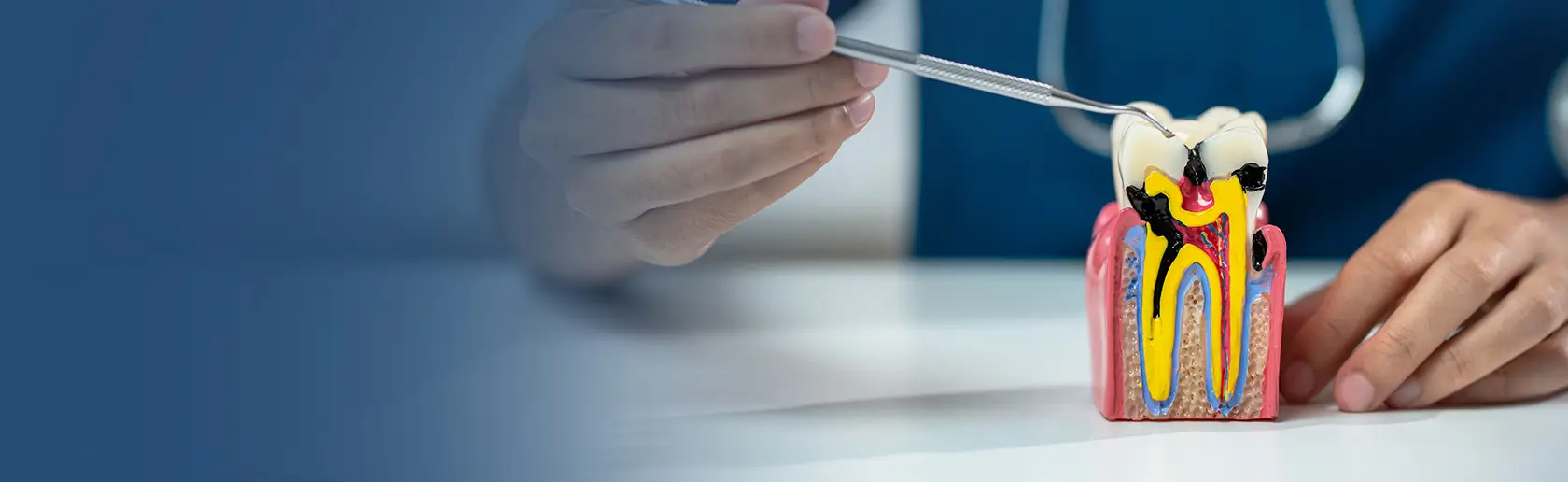
- Microscope & Laser-Assisted Root Canals: We use dental microscopes to see tiny details inside the tooth for unmatched precision. We also use lasers to clean and disinfect the root canals.
- Digital Tools for Root Canals: We use modern digital tools—like apex locators and advanced rotary instruments—to measure and clean the root canal precisely. This makes your procedure faster and more accurate.
- Single-Sitting Root Canals: When appropriate, we can complete your entire root canal treatment in a single visit, saving you a lot of time.
- Customized Posts & Cores: After a root canal, we place a custom-made post inside the tooth to give it extra support and strength, so that it’s highly durable.
- Thermoplastic Filling Techniques: We use a special warm filling technique that flows into every tiny space inside the root canal, providing a complete, 3D seal to prevent any future reinfection.
- Redoing Failed Root Canals: If a previous root canal didn’t heal correctly, we have the expertise to re-treat it. We can often save a tooth that was thought to be lost.
- Complex Cases: We specialize in managing the most difficult situations, including teeth with unusual anatomy, severe calcifications, or resorption, using our advanced tools to get the best result..
- Replantation & Transplantation: For a knocked-out tooth, we can often replant it to save it. We can also transplant a healthy tooth from one part of the mouth to another in certain cases.
- Rebuilding Severely Damaged Teeth: After a root canal, we have multiple ways to restore a severely damaged tooth, from a protective crown to a full implant if needed.
- Saving teeth that would otherwise need to be extracted
- Our use of microscopes and digital tools ensures unmatched precision and a more predictable outcome.
- Incredible expertise to re-treat failed root canals, saving a tooth that was thought to be lost.
- Our treatments are designed to provide lasting relief from pain by getting to the root of the problem.
- Are root canals painful?
Modern techniques with proper anesthesia make root canals comfortable, often less painful than the original toothache. - Can all teeth be saved with root canal treatment?
Most teeth can be saved unless there’s insufficient tooth structure or untreatable root fractures. - Can a root canal be redone?
Yes, at Second Grinnings, we specialize in endodontic retreatment for cases that were previously unsuccessful or incomplete. - Can a root canal be done in one visit?
Yes, in select uncomplicated cases, the treatment can be completed in a single sitting.

- Same-Day Teeth: We can often give you same-day teeth, placing the implant and a temporary tooth in just one visit when conditions permit, so you don’t have to wait for your new smile.
- All-on-4 / All-on-6 Solutions: This procedure uses just four or six strategically placed implants to support a full set of beautiful, new teeth, often without the need for bone grafting.
- Laser-Assisted Implant Maintenance: We use advanced laser technology to gently and effectively maintain your implants. This is to protect the surrounding gums and bone for the long-term health of your implants.
- Implants are a fixed, permanent solution that can last a lifetime.
- They look, feel, and function just like your natural teeth.
- They prevent bone loss in the jaw, helping you maintain your facial structure.
- What is a dental implant?
It is a small post that acts as a new tooth root, providing a stable foundation for a replacement tooth. - Is the implant procedure painful?
The procedure is comfortable, and any post-operative discomfort is easily managed with medication. - How long do implants last?
With proper care, dental implants can last a lifetime. - Can I get an implant to replace my missing tooth?
Most people are good candidates, but a consultation is needed to assess your bone health before treatment is prescribed.

- Child-Friendly Dental Care & Sedation: We create a compassionate and calming environment for our youngest patients. For children with anxiety, we can use conscious sedation so that they feel comfortable and relaxed throughout the entire procedure.
- Digital Cavity Detection: We use advanced digital tools to accurately detect cavities in their earliest stages, often before they’re visible to the naked eye. This allows for the most minimally invasive and gentle treatment possible.
- Growth Monitoring & Early Orthodontics: We don’t just look at teeth—we monitor your child’s overall dental and jaw development. This proactive approach helps us prevent or reduce the severity of future issues.
- Our advanced technology ensures your child receives the most gentle and least invasive care possible.
- We lay the foundation for a lifetime of healthy teeth and a confident smile.
- Our proactive approach helps prevent major orthodontic issues from developing.
- When should my child first visit the dentist?
The American Academy of Pediatric Dentistry recommends a child’s first visit by their first birthday or when their first tooth appears. These early visits help us monitor development and provide you with guidance on at-home care. - Are dental X-rays safe for children?
Yes, digital X-rays are very safe for children. They use a very low dose of radiation, and we use special protective equipment to ensure your child’s safety and comfort. - When do baby teeth need to be treated?
Treating baby teeth is important for eating, speaking, and holding the space for permanent teeth. Keeping them healthy prevents pain, infection, and promotes proper jaw and tooth development. - Can my child’s thumb-sucking or pacifier use cause dental problems?
Prolonged thumb-sucking or pacifier use that continues past the age of three or four can affect a child’s jaw growth and lead to misaligned teeth or bite problems. We can work with you to provide guidance on how to stop the habit when the time is right.
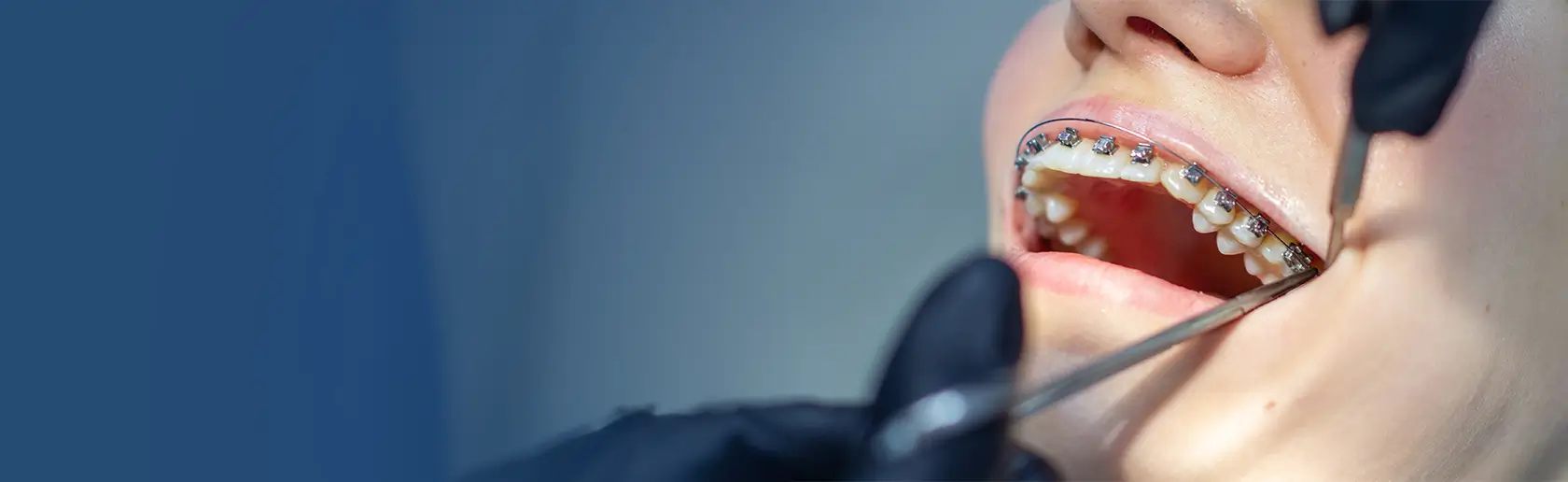
- Clear Aligners: We use clear, custom-made aligners to gradually and discreetly move your teeth into the correct position. This is a popular and comfortable option for mild-to-moderate cases.
- Braces: Braces are a time-tested way to correct misaligned teeth and bite problems. We offer various types, including traditional metal and more discreet ceramic options.
- Jaw Surgery: For more complex cases, jaw surgery can be used to correct severe jaw alignment issues. This procedure helps to restore both facial harmony and proper bite function.
- Habit-Correcting Appliances: We use specialized appliances to help correct habits like thumb-sucking or tongue thrusting, which can affect a child’s dental development.
- Jaw Corrections During Growth: For children still growing, we can use appliances to guide their jaw development. This proactive approach helps to prevent more serious issues in the future.
- Correcting your bite improves chewing function and prevents issues like wear and jaw pain.
- We offer a variety of options, from discreet clear aligners to traditional braces, to fit your lifestyle.
- Early orthodontic treatment can guide jaw growth and prevent the need for more complex procedures later.
- By correcting misalignments, we make your teeth easier to clean, helping to improve your long-term oral health.
- Am I too old for orthodontic treatment?
No, orthodontic treatment can be successful at any age, and a significant number of our patients are adults. - What’s the main difference between braces and clear aligners?
Braces are a fixed appliance that we use to correct a wide range of issues, while clear aligners are removable and ideal for mild to moderate cases. - How long will my treatment take?
The duration of treatment varies for each individual, but we’ll give you a clear estimate after your initial consultation. - Do braces or aligners hurt?
It’s normal to feel some soreness or discomfort for the first few days after an adjustment, but it’s manageable and will quickly fade. - Can I eat normally with braces?
You can eat most foods, but we’ll give you a list of foods to avoid that could damage your braces or get stuck. - What happens after my braces or aligners are removed?
We will provide you with a retainer to wear as prescribed, which is crucial for maintaining your beautiful new smile for life.

- Laser Gum Therapy & Flap Surgeries: Our practice uses advanced laser therapy and surgical procedures to treat gum disease and infections.
- Guided Tissue & Bone Regeneration: For more advanced cases of gum disease, we use special guided tissue and bone regeneration techniques. This involves placing materials that help your body naturally regrow bone and tissue that have been lost due to disease.
- Periodontal Maintenance & Scaling: After your initial treatment, we provide ongoing periodontal maintenance. This includes regular deep cleanings (scaling and root planing) to keep gum disease under control and ensure your long-term oral health.
- Laser Lip-Tie and Tongue-Tie Removal: We use a gentle dental laser for the quick and comfortable removal of lip-ties and tongue-ties. This procedure helps with issues related to feeding, speech, and dental development in children and adults.
- Laser Crown Lengthening: When a tooth is too short or a crown needs more support, we can perform laser crown lengthening. This procedure gently re-shapes the gum tissue to expose more of the tooth, improving both its appearance and function.
- Laser procedures lead to faster healing, less bleeding, and minimal post-operative discomfort.
- We can help you keep your natural teeth for life by regenerating lost bone and tissue support.
- A simple laser procedure can quickly and comfortably correct lip-ties and tongue-ties.
- We can use laser technology to reshape your gums, improving the appearance of your smile and teeth.
- What is gum disease?
It’s an infection of the gums that, if left untreated, can lead to tooth and bone loss. - Is laser gum therapy painful?
No, it’s a minimally invasive procedure with less bleeding and a faster recovery than traditional surgery. - What is a lip-tie or tongue-tie?
It’s a condition where a small piece of tissue restricts the movement of the lip or tongue. - How do you treat advanced gum disease?
We use surgical procedures and may perform bone and tissue regeneration to restore lost support. - Why is periodontal maintenance necessary?
It’s crucial for controlling gum disease long-term and preventing it from coming back.
